Thursday, November 10, 2011

Date With Destiny?

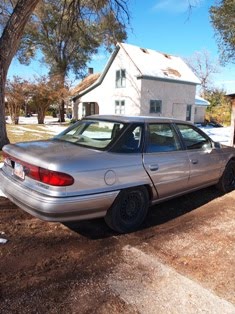
Stories of our vehicles are common at Rural Ways, especially stories of the Sable—a living legend. More than two years ago, we were ready to say goodbye to the car because it had been diagnosed with inoperable transmission failure. Read about it HERE. Since then, we have driven it another 15,000 miles, including multiple trips to Salt Lake or Ogden and back. The transmission periodically acts as though it is finished, and then rights itself and keeps going.

Last week, however, we noticed a new noise coming from the motor. I thought it was a bad bearing in the water pump or the air conditioning compressor. But, we took it over to Reese for a diagnosis. Nope, he said, not the water pump: The camshaft bearings are bad, and you need a new engine. The guy practically kicked Valerie and the car off his property because he didn't want the motor to break apart in his yard. He told us to get it to the junk yard before was too late. So, naturally, we're still driving it. I mean, one terminal illness is no worse than any other, right? (As my father-in-law is always saying, "I'll probably die with it rather than from it.")

In any case, I am concerned about having the Sable give its all in the middle of a busy freeway, so we are now under a very tight travel restriction—it goes no farther than the True Value. Plus, I talked to the guys over at the salvage yard, and they told me that they'd give me $150 for it if they had to pick it up, and more if I could get it to their yard myself. (The auto salvage business has got to be the last redoubt of the professional thug . . . I've never seen so many dim-witted but over-muscled guys with vicious dogs in my life.) The best way to ensure delivery to the junk yard is to drive it over there right now, but, who knows, maybe the thing will go another two years.

Tuesday, November 8, 2011

The Civilization of the West

A friend of mine, Colonel Benson, tells a funny story on himself: He was interviewing the guidance counselor at a school to which he was considering sending his son. The person, hoping to influence his decision, told him that the school would teach his son about the history, the culture, the art, and the philosophy of the "west." Benson was sold. He'd grown up in Montana, and his forebears had been fighting the wilderness for generations. He was thrilled that his son would become familiar with each of the Mountain Men. It was only later that Benson realized that the "west" meant Homer, Cicero, and Constantine, not Glass, Sublette, and Johnson. Benson, of course, did not need to tell anyone that story, but he used it as an introduction to his favorite book, which he was in the process of lending me. The book is called, "Crow Killer, The Saga of Liver-Eating Johnson."

While Crow Killer is a fast-paced, non-fiction (but partly legendary) account of one of the most famous nineteenth century Mountain Men, what struck me about it was that it was a story of loss. As each successive wave of settlement has crashed over the American west, the country has changed, and those who were here before have felt the loss of what they knew. The authors do not speculate regarding the feelings of the tribes—the Crow, the Shoshoni, the Flathead—as the Mountain Men began to bring change to the country, but they finish the story by noting that the Mountain Men themselves regretted the end of their own era and hated the influx of wagon trains, railroads, and cattle herds.

And on and on it goes. The "west" is now home to more than 30 million people, and rare is the corner unreached by motor or cell phone. While there is some fake (finger pointing) remorse from the pseudo-environmentalist soul patch crowd, the fact is that as Americans we want it all: We want wilderness this morning and a brew pub at happy hour; we want the back-country after breakfast and access to commercial air travel by 3pm; we want to stop development by noon and fill up our tanks in time for the commute home. I guess, like Colonel Benson, we should all have a laugh at ourselves and hope our kids grow up knowing both Homer and Hugh Glass. (My reader was probably wondering how I was going to try to tie this whole mess together. Tada.)

Sunday, November 6, 2011

Long Term Repeat Photography

Cameras have been around long enough, and there are so many good older images available, that it is now possible to return to areas that were photographed decades or even centuries ago and repeat the process. The outcome of long term repeat photography is not only visually interesting, but has been used by scientists to assess landscape level anthropomorphic change. (Perhaps most famously, at least in my line of work, by Charles Kay.) The technique is, however, only effective when things do change. Over the course of 100 years, vegetation may change, but, often, geology does not. Which makes the business of long term repeat photography difficult for those of us making pictures of rock.


The photo-graph to the left was made by E.O. Beaman in 1871. Mr. Beaman was a member of Major Powell's second expedition, and he made this picture at a place that the expedition called Bowknot Bend. At image left is a view looking downstream along the Green River; at image right is a view looking upstream along the Green River. In between is a large plateau that forces the river into a six or seven mile bend. Beaman carried the heavy photographic equipment of his era up the left side, and was picked up by the rest of his crew on the right side after they floated their three boats around the bend.


Almost exactly 140 years later, Rural Ways made this second picture, standing, without knowing it at the time, almost exactly where Mr. Beaman stood. Clearly, very little has changed, geologically speaking, since JWP and the boys were here. Two things can, however, be noted. First, on the extreme left edge of the 2011 image there is a faint scuff of sand along the far riverbank. The scuff marks the edge of a dirt road. The road is open to the public, which means that modern photographers will, almost surely, be making pictures with the roar of ATVs in their ears. This is a joy that I doubt Mr. Beaman had the pleasure of experiencing. Second, the large sandbar, visible at lower right in both images, is now covered by Tamarisk or Salt Cedar (Tamarix ramosissima). Salt Cedar is an aggressive non-native plant that was introduced to North America in the early 1800. It does not appear to be present in the Green River riparian area in 1871. Today, it has obviously covered most of the long term sandbars along the entire waterway.

In any case, I'll close this post with another quote from my favorite river narrator from 1871, Frederick Dellenbaugh: "The next morning we remained here till ten for views, and then we left Beaman on the summit of the low dividing ridge, where one could look into the river on either side and see a point which we rowed more than five miles to reach. On the right bank we stopped for dinner, and when it was about ready several of us crossed, and, helping Beaman down with his heavy boxes, ferried him to our side. The opposite bank was no more than one thousand feet in a straight line from our starting-place of the morning."

Thursday, November 3, 2011

Cat and Mouse

"If any will not work, neither let him eat." Did the Apostle Paul intend for his famous admonition to apply to cats? Because, if so, the pictured feline will be seeing a drastic reduction in the daily distribution of kibbles.

One of our neighbors has been dealing with a mouse infestation, brought on primarily by the presence of loose chicken feed out by his chicken coop. As the fall weather strengthens, we are beginning to see a spill-over effect. It seems that mice, not knowing where the property line is located, have been coming to The Homestead for shelter. Once inside, they have been snuggling in for the long winter. There is no way that Rural Ways is going to share a pantry with mice, so I have been trapping them.

While killing mice is a somewhat unpleasant task, I would be much happier about it if I hadn't just spent the last six years sheltering a cat. If the cat can't take care of the mice, why am I supporting her? I suppose that we have been too soft. We have supplied her with store food for many years, which is likely to have blunted her native ferocity. Perhaps some rationing of the free food is in order.

(The fact that the object of my ire is currently napping in front of the woodstove is not helping her case.)

Tuesday, November 1, 2011

Heating Improvements?

It is November 1st and, right on time, we've got a cold, blustery winter storm blowing through: Lows in the teens have been forecast. Fortunately, over the summer, Rural Ways added 10 bales of insulation to The Homestead. In addition, we renovated the screen porch and added a ventless gas heater to warm it. Two more heaters are either installed or planned for the bathroom and bedroom, respectively. With all that, you'd think we'd be living like those people from Vegas who have adopted shorts, flip-flops, and tank-tops as a uniform. Well, you'd be wrong. For one thing, heat isn't free, and for another, it doesn't work when it is turned off, which, under the frugal regime at Rural Ways, it often is. So, pull on the long-johns, the sweat-shirts, the Sorrels, and the ski hat, and get ready for winter weather . . . indoors.